
Authored by Dato Ir. Muhammad Imran Bin Dato Baharuddin, P.Eng, MIFE, MIEM,
ASEAN Engineer, Managing Director of Dexalon Sdn. Bhd.
Ir. Alan Chan, P.Eng, MIEM, MSFPE
Er. Ho Victor, P.Eng, FSE, Reg Insp(M&E), MSFPE
Yeong Ming Yew, MSc. B.Eng.
Abstract
The purpose of this work is to study the attenuation of the radiative heat flux along the egress path, with sprinklers’ discharge between the egress path and the seat of fire.
Numerical simulations were conducted for a 12MW fire underneath an open-sided shelter with a height of 3.4m. An open-to-sky egress path is designated at 7.4m (perpendicular distance) from the seat of the fire. In the first simulation, there are no sprinklers in the whole simulation domain. In the second simulation, 6 nos of sprinklers in a row were set up between the seat of the fire and the egress path.
Simulation results showed that on average a 6% reduction of the radiative heat flux can be achieved with sprinkler discharging at the aforementioned locations. This implies that sprinklers’ discharge could attenuate the radiative heat flux, thereby reduce the occupants’ exposure to fire hazard during egress/evacuation pass a fire/egress pass a fire.
Introduction
Fire incidents in buildings often lead to severe damage of physical properties and loss of lives. In order to minimize potential damages that could arise, building fire codes are developed and enforced in many countries across the world.
Typically, building fire code requires a building to remain tenable for at least certain duration of time once a fire broke out. To achieve this, building owners are required to adopt various preventive measures & install passive & active fire-fighting installations for the buildings
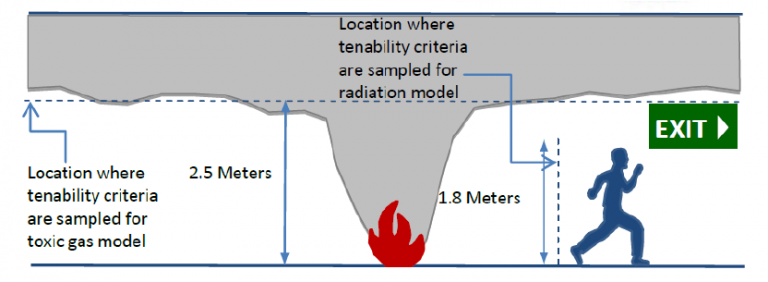
According to [1] parameters for an assessment of tenability include: visibility, gas temperature, and radiative heat flux. At 2.5m above the floor level, the visibility shall be greater than 10m, while the average upper smoke layer temperature shall not exceed 200°C. Where occupants are expected to egress past a fire, the radiative heat flux shall not exceed 2.5 kW/m2 (Fig. 1).
Methodology
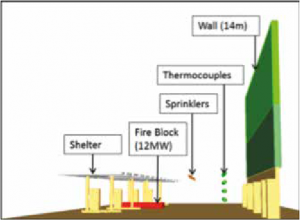
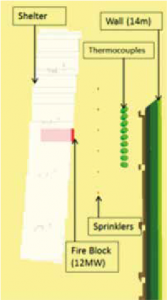
PROBLEM DESCRIPTION: A 12MW t2 fast fire is modeled underneath a 3.4m high open-sided shelter. The roof of the shelter has a dimension of 33m [L] x 6m [W]. A 14m high wall is located at 10.4m away from the longer side of the shelter (Fig. 2 & Fig. 3). The egress path is designated between the shelter and the wall. It is located at 7.4m perpendicular distance from the seat of the fire to the left, and bounded by a wall 3m to the right.
As the shelter is open-sided and the egress path is open to sky, the tenability criteria for visibility and gas temperature at 2.5m are not the main concern. Smoke flows upwards by its own buoyancy and is discharged to the surrounding.
Fire Dynamics Simulator
Fire Dynamics Simulator (FDS) was utilized to conduct the numerical simulation. FDS is a computational fluid dynamics (CFD) model of fire driven fluid flow. FDS solves numerically a form of the Navier-Stokes equations appropriate for low-speed (Ma<0.3), thermally-driven flow with an emphasis on smoke and heat transport from fires [2].
Fire Size & Fire Growth Rate
The peak heat release rate (HRR) of a vehicle is taken as the reference for the fire size of the fire load in the simulations. Typical peak HRRs for different road vehicles are tabulated in [3]. For a passenger car, peak HRR ranged between 5-10MW. For a light duty vehicle, it is 15MW. The fire size selected is 12MW, which exceeds the upper boundary of the range for a passenger car and below that for a light duty vehicle.
According to [4], the fire growth parameter for a car under un-sprinklered condition corresponds to medium fire growth rate. In the simulation, a fast fire growth rate is used for conservative purpose.
Upon reaching 12MW, the HRR remains constant. This is a conservative approach as HRR typically declines after reaching the peak, as the amount of combustible gradually reduces as the fire continues.
Sprinkler Setup
6 numbers of sprinklers are set up at 3.6m perpendicular distance from the seat of the fire (Fig. 2 & Fig. 3). The separation between the sprinklers is 3m. The sprinklers are set up at the same height as the roof of the shelter (3.4m).
Typically activation temperature for sprinkler is >60°C. In the simulation, the sprinklers are modelled at locations which are open to sky, far away from the fire source.
The jet stream of the sprinkler discharge is modeled in conical form, with a flow rate of 1L/min. The water droplets have a median diameter of 500μm. Constant droplet size distribution is selected.
Thermocouples
Setup To measure the radiative heat flux an occupant is exposed to during evacuation, thermocouples are set up along the egress path from 1m to 4m above floor level (z=1m to 4m). A total of 36nos thermocouples are evenly distributed over a 8m long stretch along the egress path closest to the seat of the fire (Fig. 2 & Fig. 3). The thermocouples are set up at 1m interval in horizontal & vertical direction.
Mesh
Fine mesh (0.2m, uniform in x, y and z direction) are used for simulation domain from z=0 to 3.6m. The fine mesh zone covers domain where fire and sprinklers are located. In order to reduce the number of cells and computational costs, coarse mesh of 0.4 x 0.4 x 0.2 (z) is used for z=3.6m to 10m. The total number of cells for the entire simulation domain is 1.46 million. The simulation has run for 1200 seconds.
The dimensionless expression D*⁄δx can be used as a measure to determine how well the flow field is resolved [fds manual]. D* denotes the characteristic fire diameter, while δx denotes the nominal size of a mesh size.
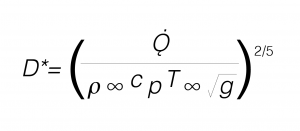
D^* is dependent on the heat release rate of the fire block, gravitational acceleration, and properties of ambient air (density-, temperature & heat capacity. In the mesh sensitivity study for [NUREG 1824], D*⁄δx ranged from 4 to 16. For the simulation domain with fine mesh, D* = 4.12, which is within the range.
Results and Discussions
The measurements from thermocouples over the simulation duration are plotted. For the comparisons of the radiative heat flux for scenario without sprinklers discharge & with sprinklers discharge, the most notable difference is observed for measurements at z=2m. Hence, the results at z=2m is representative and discussed in this section.
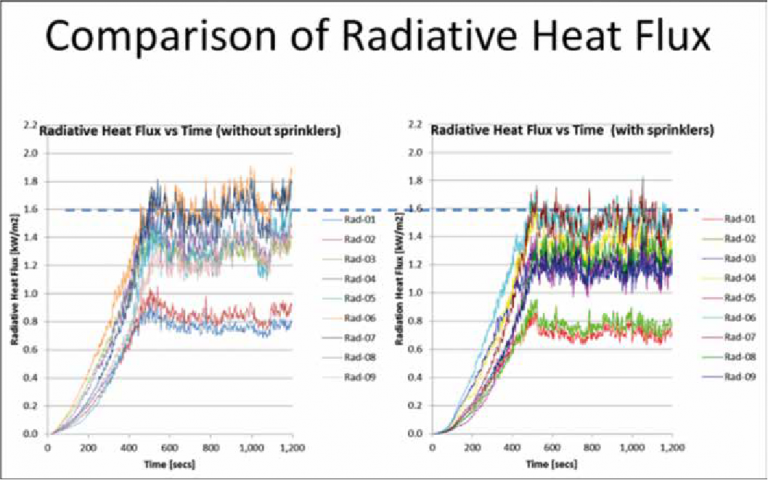
Fig. 5 shows the radiative heat flux vs time for scenario without sprinklers discharge (left) & scenario with sprinkler discharge (right). It can be observed that the peak radiative heat flux for both scenarios are <2.5kW/m2 (the threshold above which is deemed hazardous for human). In both scenarios, Thermocouple 1 & 2 measured lower value; while Thermocouple 6 & 7 measured higher value.
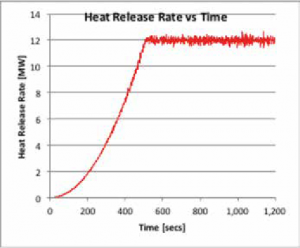
The radiative heat flux measured by the individual thermocouple increases quadratically at the beginning of the simulation. At approximately 500secs, the radiative heat flux reaches the peak, thereafter fluctuates randomly about its mean.
This is consistent with the development of the HRR of the fire block, which exhibits similar growth rate and reaches the peak at approximately 500secs (Fig. 6).
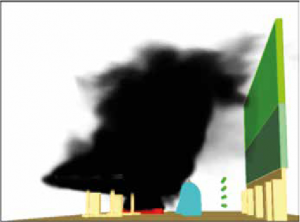
In Fig. 4, it can be observed that the smoke plume buoyed up from the roof of the shelter. Only scarce traces of smoke are observed in the direct vicinity of the thermocouples. Despite that, considerable amount of radiative heat flux is measured (between 1.2kW/m2 to 1.6kW/m2) along the egress path. Hence, it can be deduced that the thermal radiation from the fire block contributed to the bulk of the radiative heat flux measured along the egress path. For cases where there are smoke back-layering, hot smoke would also contributed to the radiative heat flux.
At the absence of sprinklers, the radiative heat flux exceeds 1.6kW/m2 for the whole simulation duration. The mean radiative heat flux is approximately 1.7kW/ m2. Occasionally, the HRR exceeds 1.8kW/m2
For scenario where sprinklers discharge,
- the mean radiative heat flux is reduced by approximately 6% (to approximately 1.6kW/m2)
- Most of the time, the radiative heat flux stays below 1.6kW/m2.
This observation suggests that sprinklers discharge is capable in attenuating the radiative heat flux.
Conclusion
Preliminary study shows that sprinklers discharge between the seat of the fire & occupants’ egress path reduces the radiative heat flux.
Results from the preliminary numerical simulations imply that sprinklers are not only effective for extinguishing/controlling a fire. In addition, sprinklers could potentially be used to add another layer of protection to occupants by reducing the radiative heat flux reaching occupants (minimizing occupants’ exposure to radiative heat flux) when a fire breaks out adjacent to an egress path.
Various factors may affect the radiative heat flux on the thermocouples. Some factors have more significant effect on the simulation outcome than the others. The influencing factors include but not limited to sprinklers discharge droplets size distribution, separation between sprinklers, flow rate, soot yield. Further studies will have to be performed to investigate the influence of different parameters on the radiative heat flux.
Outlook
- To conduct mesh independence study to improve the accuracy of the results.
- To study the influence on sprinkler specification/ water droplets size distribution on the effectiveness of sprinklers in attenuating the radiative heat flux.
- Finally the simulations are to be validated via experimental approach/fire test
Ideally, the egress path should be designed such that it is at a safe distance from any potential fire load. Should there be constraints, a performance- based design with sprinklers can be considered to address the non-compliance or potential hazards that may arise consequently.
At a direct distance of at least 7.4m from the fire source, occupants are still exposed to radiative heat flux which is not insignificant (1.6kW/m2), though below hazardous level (>2.5kW/m2). Occupants’ exposure to the radiative heat flux must be taken into account for a performance-based design, especially for building compartments with low roof/ceiling level and where smoke back-layering might occur.
Note:
The base information for this study is taken from a real performance based approach project but the name of both the project and stakeholders have beenomitted.
For further information, please contact dexalonsb@dexalon.com or admin@hilt.com.sg
References:
[1] “Singapore Fire Safety Guidelines 2015”. Singapore Civil Defence Force
[2] “Fire Dynamics Simulator User’s Guide”. K. McGrattan, S. Hostikka, R. McDermott, J. Floyd, M. Vanella
[3] “Design Fire Characteristics for Road Tunnels”. World Road Association
[4] “Design Fires For Use in Fire Safety Engineering”. C. Mayfield, Danny Hopkin