A common search on Google will reveal a basic and layman definition of Fire Engineering as ‘Fire engineering is the application of science and engineering principles to protect people, property, and their environments from the harmful and destructive effects of fire and smoke.’
The advent of technology has brought upon the rail industry to move large quantity of people using trains. Trains generally carry large amount of people and will be susceptible to a higher potential of casualties in the event of a tunnel fire compared to a road tunnel. Malaysia will be joining the list of countries with a large network of Mass Rapid Transit with the MRT 1 completion date scheduled to be in Middle 2017. Two events in recent years have highlighted the horrendous scale of possible consequences of fires in mass transit (metro) systems in 2003, nearly 200 people died following an arson attack on an underground railway/metro in South Korea: and in 1995, over 200 people died following an electrical fire on an underground railway/metro train in Azerbaijan [1].
The author of this article hopes that the application of fire engineering is able to mitigate or prevent the risk of fire in the rail industry in Malaysia and therefore contribute towards a safer rail environment.
The Fire Engineering Process
The most commonly used reference is the International Fire Engineering Guidelines 2005 [2] which gives a perspective of the various approaches to Fire Engineering in the various countries that fire engineering is advocated. Jabatan Bomba dan Penyelamat Malaysia (JBPM) recognises this guideline as a first step towards preparation of the Fire Safety Design Philosophy (FSDP) for the railway development. The flow chart for the preparation of the FSDP is as in Figure 1.
Figure 1 – FSDP Process
The Authorities Having Jurisdiction and the common reference codes
The various parties involved in the fire engineering exercise from the authorities are the National Security Council, Fire and Rescue Department ( Jabatan Bomba dan Pemyelamat ), various municipal councils that the trackway crosses and Land Public Transport Commission (Suruhanjaya Pengangkutan Awam Darat).
The common international reference used are the NFPA 130 [3] and the various sub clauses in the Uniform Building By Law 1984 (UBBL 1984).
Computational Fluid Dynamics (CFD) simulation and Egress simulation
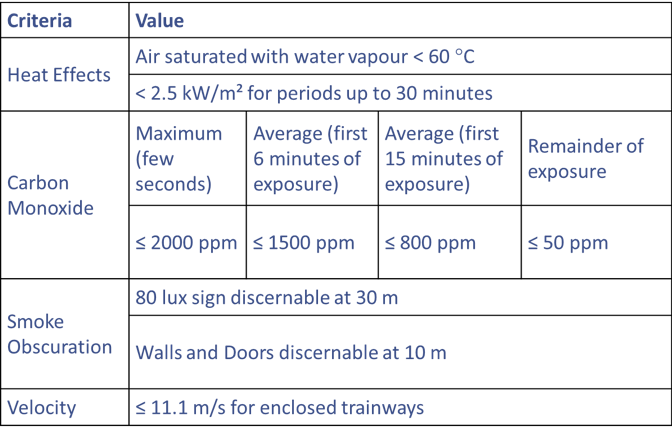
CFD is commonly used to show the compliance of the tenability criteria. The common tenability criteria taken at 2.5m above the finished floor level used are shown in Table 1. This is normally used for the tenability criteria for the passengers in the train station
Table 1 – Common Tenability Criteria
A sample CFD result is shown in Figure 2. This CFD was done independently to verify the results of the base Fire Engineer to ensure compliance and consistency with the design guidelines.
Figure 2 – Sample of the CFD Analysis
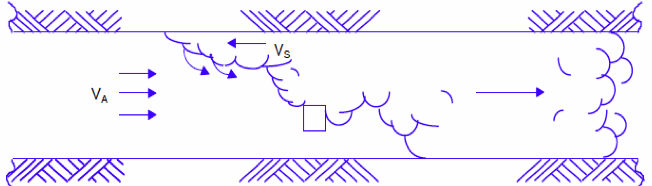
Another CFD key function is also to ensure that the critical velocity in the tunnel is met. This is to ensure a safe environment for passengers in the tunnel in a fire emergency. Critical velocity is the minimum steady state velocity of the ventilation airflow moving toward the fire within a tunnel or passageway that is required to prevent back layering at the fire site [3]. An illustration is given in Figure 3 where VSis the velocity of the leading edge of the smoke layer and VAis the critical velocity needed to minimize back layering. The objective is to ensure that VA> VSso that the area upstream from VAwill be clear and safe for the passengers to detrain and escape to safety in a tunnel.
Figure 3 – Critical Velocity
Another key feature in the practise of verification required by JBPM is the egress simulation on top of the requirements of Annex C of the NFPA 130 for the a) Platform evacuation time of 4 minutes or less and b) Evacuation time to a point of safety: The station shall also be designed to permit evacuation from the most remote point on the platform to a point of safety in 6 minutes or less.
Testing and Verification
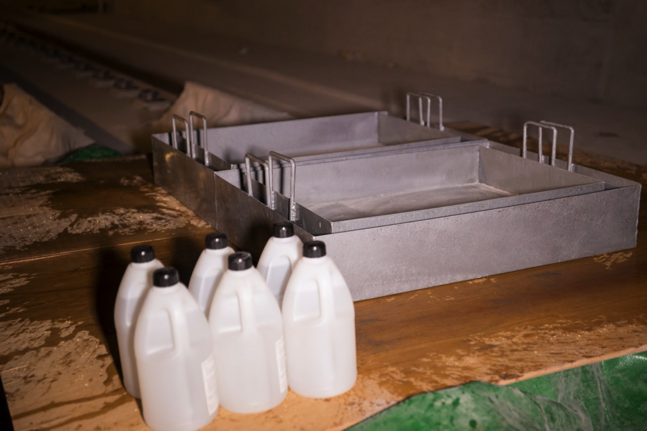
The common saying of the proof of the pudding is in the eating. Testing and verification of the design are essential to prove that what is on the drawing board has been constructed and installed on site. The common fire test procedure is given in AS 4391 [4]. The pictures/figures below shows the actual setting up of the fire test for
Bukit Berapit Tunnel, a twin bore single track railway tunnel with approximate length of 2896m done by the author’s firm for the acceptance test by JBPM.
Figure 4 – Apparatus used in the fire test
Figure 5 – Setting up of the Fire Test.
Conclusion
Fire Engineering as a professional field is still relatively new but has been recognised as an essential tool to be used in creating safer environment especially in the rail industry.
Reference
[1] Beard, Alan, and Richard Carvel. The Handbook of Tunnel Fire Safety. London: IC, 2012
[2] International Fire Engineering Guidelines. Canberra, ACT: Australian Building Codes Board,2005
[3] NFPA 130: Standard for Fixed Guideway Transit and Passenger Rail Systems. Quincy, MA: National Fire Protection Association 2013
Dato’ Ir Muhammad Imran bin Dato’ Baharuddin PE is the managing director of Dexalon Sdn Bhd which is a registered Fire Safety Engineering company with JBPM and also with offices in Singapore and Australia. He was personally involved as the Peer Reviewer of the KVMRT 1 and is the principal fire engineer for KVMRT 2 – aboveground stations and KVLRT 3. His vast experience in fire engineering which spans more than 35 years has taken him to complete numerous mega projects such as KUALA LUMPUR CONVENTION CENTRE (KLCC),KUALA LUMPUR INTERNATIONAL AIRPORT (KLIA).